Organic Stories
Stand at the international fair for organic professionals Natexpo
Organic Stories
Sector
Culture, Lifestyle & Food
Expertises
Sub-expertises
- Trade shows
Putting the bio in the spotlight
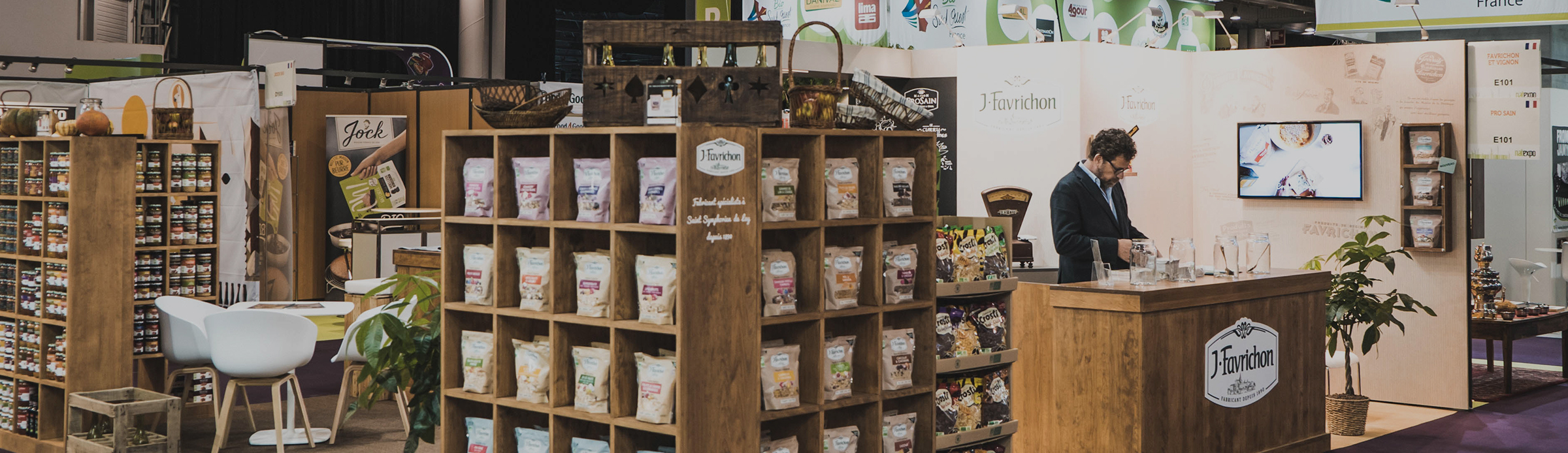
The Organic Stories group consists of two companies: Favrichon, processing and manufacturing organic cereals, and ProSain, specialized in the production of organic vegetable preparations. As part of the Natexpo fair taking place in the fall, both brands wish to be represented at the same 40m2 stand. However, although both brands share the same values, they have distinct graphic universes that need to be respected and coexist. One of the other challenges of this project is to allow the stand to convey an image of healthy products, sourced from organic agriculture, respectful of nature. The 148 agency benefits from technical expertise (CSS) to adapt the interface of this program to the needs of the major brands that use this service. The agency's teams highlight their skills in development as well as in artistic direction and strategy.
An original scenographic concept
It is therefore about designing a reusable stand as much as possible, which is why most structures are envisioned in wood and fully dismountable so that they can be reused for other trade shows.
Indeed, in general, it is common for stands to have a very short lifespan, usually just for the duration of a trade show, and this notion of waste clashes with the values of agency 148 as well as those of the client.
The other important point is to manage to subtly coexist the two universes.
Thus, the Favrichon area is inspired by the world of grocery stores, while the ProSain area refers more to the codes of a kitchen that one might find at home. That is why the creative team of the agency first proposes inspiration boards (moodboards), then numerous sketches, as well as several 3D situational renders to conclude. These steps are necessary for the smooth progress of the project for both the client and the stand builder of agency 148.
A customized stand that is intimate and warm
To animate the booth, a chef is specifically made available to create numerous preparations using ProSain products. These recipes are hand-drawn by an illustrator and placed on a slate background to give the illusion that they are sketched in chalk.
Many vintage decorative elements are scattered throughout the booth (old milk cans, glass jars, old scales, wicker or metal baskets, and wooden crates). Additionally, some plant elements (gourds, seasonal fruits, and green plants) are placed here and there to highlight the eco-friendly approach of both brands.
All these decorative elements come from salvage markets and are reused in order to avoid any waste. As for the various structures (counter, shelves, stools), everything is made of wood while being designed to be disassembled and reconstructed as desired.


Contact us
With us, your project will become a reality!
The Collective Agency brings together many talents who can respond to strategic and/or operational communication projects, targeted or multi-channel, short and long term. Do not hesitate to make an appointment with us to discuss and receive a quote for your project!
Contact us